
My biased advice about biased advice.
When I talk to founders, I get worried. Not about their ideas, but about their information diet. It used to be a Dragons' Den understanding of equity; now it's a smorgasbord of podcast certainty, LinkedIn playbooks, and LLMs serving the average of everyone else's noise.
Successful founders create lots of noise, new founders start listening to this noise, and the majority who fail quietly disappear. The survivors then reinforce the narrative, and the cycle repeats.
The problem is that the noise comes from the smallest and loudest group: the ones who made it through. They talk back to those still at the beginning, where failure is most common and the struggle is greatest. Often they are talking from a different market, a different geographic cluster, or even a different time. The noise comes at the end of the journey, and the pain is concentrated at the beginning.
I’ve lived every side of this. As a failed founder, an exited founder, an angel investor, and a mentor. I’ve watched hundreds of bright, ambitious and capable people set off into startup land. Some with tremendously successful businesses, and the majority not so fortunate.
Why noise, and not advice? Run a coin-tossing competition with 1,000 people and someone will win ten in a row. They will happily lecture you on their winning technique afterwards. Now suspend disbelief and imagine that an entrepreneur’s success works the same way: it’s entirely down to luck. No skill, just luck. I know, hard to imagine.
Who gets to talk to the would-be entrepreneurs in this world? Simple: entrepreneurs who have sold their businesses, and people who have invested in entrepreneurs who have sold their businesses.
Why? Because they’re the easiest to find and are usually more than happy to talk about themselves. Investors market themselves to see more deals, and so capture more luck. Some entrepreneurs reinvent themselves as investors. Some can truly just want to give back (I know a good few of these), and some just like the sound of their own voice – the Frank Sinatra School of startup (more on that another time).
What do they say? It’s definitely not “I got lucky, good luck”. The desire to ‘look skilful’ is strong.
This is the vicious circle. Even in a world where success is 100% luck, human incentives manufacture an industry of entrepreneurial hype. The lucky lecture, the listeners take notes, and some go on to succeed and credit the lecture. Traits that were correlated with success become the success doctrine. We build a startup monoculture around the noise of random, lucky founders.
Bias is real. Whilst we are not in a world that is 100% luck, these reinforcing cycles exist nonetheless. And they don’t make advice useless, they make advice dangerous. Advice is always biased and always context dependent. It serves the interests, worldview, and incentives of the person giving it more than the person receiving it.
Context is key. The US is not the UK. 2026 is not 2008. Deep tech was never SaaS. AI is not either of them. A privileged Oxbridge founder faces a different set of constraints from a minority founder without those pre-built networks. (For the record: I’m the privileged one.) What worked in one context (personal, geographic, temporal, technological) may be disastrous in another – and it’s the founder who lives with the consequences.
Experience is armour. Advice lands hardest on the people with no prior experience to evaluate it. First-time and minority founders are most vulnerable to getting burned by being told ‘this is how it works’. They don’t know yet which parts are universal, which are local, which are just mythology with a cap table.
So fucking what. Should everyone ignore advice? Do we want to wait 20 years so academics can generate some papers on what strategies technically did work at the time? No. But…
Founder success stories are autobiography, not instruction. They can tell you a lot about a time, place, market, and circumstances that you are likely never to encounter. They can be inspiring and useful. They are not instructions or recipes for success.
If founders take them as recipes they can do real damage. And the founder is the one on the receiving end of that damage. They can make first-time founders feel that everyone else came preloaded with the right instincts, networks, confidence, skill. Or that unquestioningly copying what some US VC-backed founder did will lead to success in their own context.
Context isn’t cheap, but it is critical. And it isn’t always obvious where it’s needed when the noise becomes more and more homogeneous. Ask an LLM about entrepreneurship and you’ll usually get a smooth, Silicon-Valley-airbrushed narrative about what to do. It’s built on the noise. (Yes, I’m aware I’m about to launch a chatbot trained on my own book. At least it’s trained on a deliberately awkward data point. Have a play, it’s fun!) Entrepreneurs need to see what’s actually going on – reality – not get captured by the noise.
This isn’t anti-VC, or anti-model. The Silicon Valley VC model is the most powerful value creation and capture model of this tech era. But it works in Silicon Valley. There are lessons to be learned, not formulas to be copied. We’re all in the same system generating noise and seeing it from different vantage points. My viewpoint is steeped in UK tech as an angel investor, LP in VC funds, receiver of VC investment, and an exited serial founder.
I’ve heard a lot of advice from successful founders. I’ve given plenty too. Treat all of it, including this, as one data point that informs you, not a recipe for you to follow. If you have to take one thing from any founder’s talk, book, blog, podcast or TED talk, it should be the questions, not the answers. “What was hardest, when did you nearly fail, what did you not see coming, what worked because of that particular point in time?” That context is where useful stuff lives.
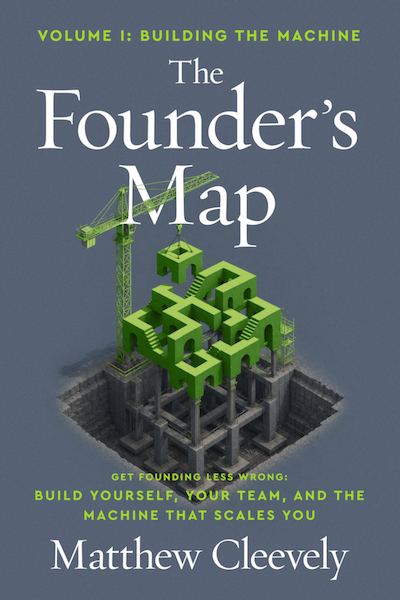
This is the problem I've spent years trying to solve. I've been writing and re-writing advice to founders for over a decade. When I sold my company I thought I'd create something that didn't try to give advice, but instead gave founders the tools to evaluate and navigate startup land. Something I would have actually learnt from. The Founder's Map is my attempt to build a practical toolkit for the problems founders actually face – personal survival, people, money, hiring, culture, fundraising, incentives, and what kind of business they are really trying to build – not the ones people in my position usually feel comfortable talking about. A map doesn't tell you which route to take; it shows you the terrain, cliffs included, so you can choose your own. 100% on the founder's side, including the part where I want you to buy it!
The Founder's Map comes in two volumes: Volume I is out this September, Volume II follows. You can pre-order the Volume I Kindle edition here. Or sign up for book news, like when Volume II lands. Or just argue with the distilled version of me on this site.
“Founding and running a company is a continuous learning journey, and most valuable lessons often come from understanding what not to do. Matthew combines the mindset of a first-principles founder with insights gained from investing in hundreds of startups to create a remarkably practical guide. Wish I'd had it on day one.”
- Sai Shivareddy, Founder and CEO, Nyobolt